Sunday, 26 March 2023

Coppicing

 Coppicing at Cairn Wood.

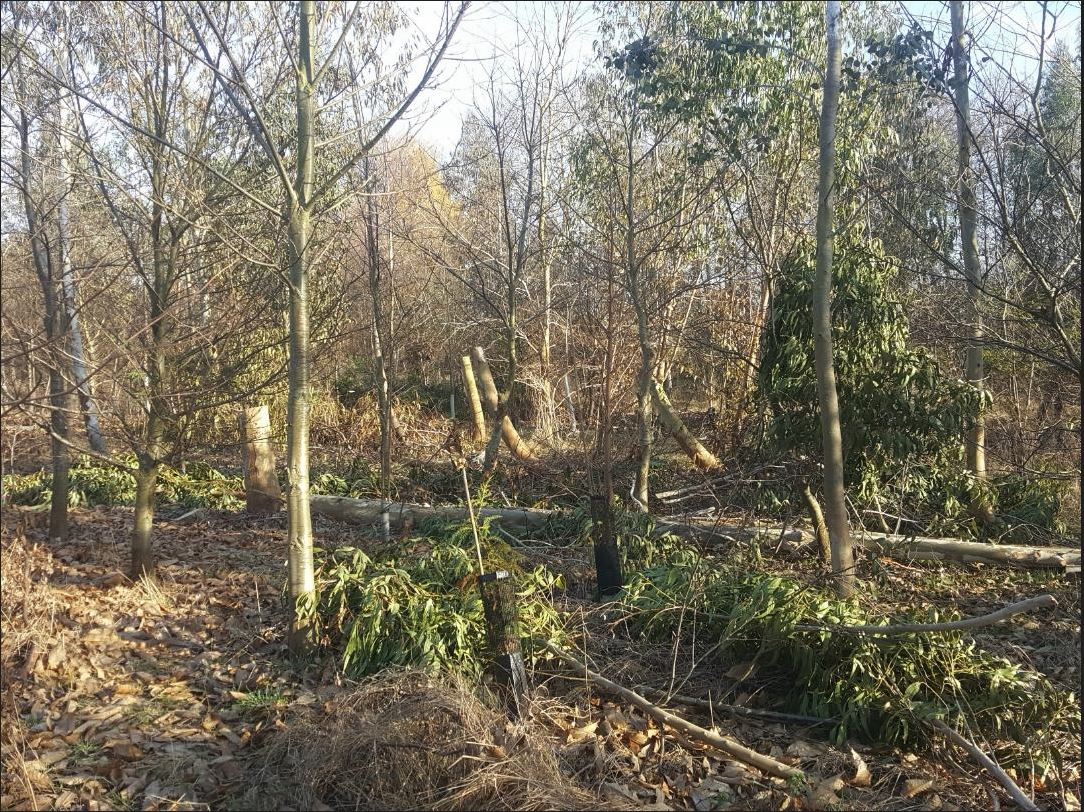
Anybody hoping to read an account of traditional coppicing is going to be disappointed. I have small patches of Willow and Hazel in Cairn Wood which I cut to provide wood that can be used and to keep them to a reasonable size. This means removing larger stems and leaving immature stems to grow on. 

S. viminalis rods used in fence,
woven between Hazel stakes.
There is an area of Willow coppice visible from the parking area looking towards the stream from the entrance gate. This is Salix viminalis which was purchased with the land. Known as Osier or Basket Willow it's withies are used for heavier  baskets. I have tried to cut out shoots or rods with a 1" diameter each year these are about 3 years old, and 8-12 foot long. Some I use in dead hedge piles or woven dead fences. A few get used as kindling or for firing the charcoal retort,  but most are not used. The Willow was cherry picked so is not the traditional lollipop shaped Osier pollard. The Willow is full of canker and not suitable for fine weaving. 

The Salix viminalis after the larger rods
have been removved. 
The other area with a lot of Willow is at the far end of the Wood where the original Salix triandra  was never totally eliminated. A smaller Willow than S. viminalis it a basket willow with several varieties with different coloured stems. This is one of the more common varieties Black Maul. There are also some other varieties which I put in to give me options should the other trees fail. The disease levels mean they could not be usable without spraying. As it grows amongst planted trees in a small neglected area. I shall cut it to favour other trees but retain it to provide shade to timber stems.


Coppiced Hazel more willow will be thrown
 around it to deter  browsing.
There are also two areas of Hazel. One is a small area between the S. viminalis and the stream. The lowest lying part of the wood winter wet and well shaded it does not grow quickly. Originally planted to keep coppice work a possibility I did not have use for it. Fortunately a coppice worker did take it down to the ground a couple of years ago. I think he did take hedging stakes and bean poles which was good. Unfortunately the coppice regrowth has been hammered by the deer. The cutting from the neighbouring willow will be thrown around the new regrowth in the hope it deters the deer.

The typical mess left by just removing larger
 rods one year later cut stems were left to
discourage deer.
.
The other bit of hazel was a continuous row separating what is now the track from the wood. Planted before the track was put in but while it was obvious that was where vehicular access would be. It was to form a hedge/barrier that I could keep under control with out paying a hedge cutter. It is nearly half a kilometre long. When the track was put in some sections were removed to make passing places. There were also no squirrels in the field when they were planted. When the Oaks were planted behind them I thought they could shade the Oak trunks when they grew. 

Potential hedging stakes  and 
bean poles.
The policy is to remove the larger rods, ones that are going to produce nuts in particular. Rods that might be suitable for making hedging stakes were selected out. Fortunately somebody has taken them, hopefully they can use the bean poles that I also sorted, but less systematically. One reason for taking the larger rods out, is to reduce the nut crop. It is not feasible to remove all the catkin bearing rods  but the crop is much reduced. Squirrel numbers have increased since the wood was planted. A supply of acorns and hazel nuts has not helped. Some peanut bird food was put out at the end of February and a trail camera revealed at least 3 squirrels. Trapping caught 5 squirrels in 6 days.
I will need to keep trapping if the Oaks are to make timber trees.


Wednesday, 22 February 2023

2022 A Summary.

 2022 A Summary.

The winter planting season 21/22 had mixed results. The first trees planted were Eucalyptus rodwayi and London Plane put into small areas of dying Ash and Downey Birch with odd other stunted trees. The areas were by the streamside at Cairn Wood. The London Plane were F2 hybrids from seed collected at Nottingham Arboretum. They were a complete failure. The brash piles failed to keep the deer out and the Eucs were heavily browsed and the Planes in their guards failed with the hot dry weather.

The main planting had been in the rectangular field where Oak, Douglas Fir and some Eucs were planted where the Poplars and Alders had been pollarded.  The trees were planted close to the pollards. Some of the Eucs were very poor specimens that had been neglected in the my nursery and had not been watered or got waterlogged once it rained. They quickly failed but the Cheviot Tree's Pedunculate Oak and Douglas were good specimens. They did get watered occasionally  through the dry spring and drought Summer. A very time consuming task. It was at least possible to get the car round the field so taking water down was possible. The dry ground did not absorb the water so each tree got a splash and then I had to wait while it soaked in before getting another splash and then a third. For the trees planted 22/23 I have planted the plastic pots for those that were in them next to the trees to make watering easier this summer. Survival has been good. 

The 21/22 plantings. The pollarded Poplars coppiced rather too well and and have been felled. They will need spraying as they regrow and will produce suckers which will need spraying. 


The winter 21/22 season and early spring also saw the pollarding of the largest Eucs (P11) in the triangular field and their splitting and stacking for burning the following winter. The larger E. glaucescens in the mixed compartment were also pollarded in the spring. These are our current fuel logs. Most of the E. glaucescens were pollarded later in the year and are drying for winter 23/4.  All the Pollards had good shoots but some have failed in the drought.

The Autumn saw the remaining Alder and poplars in the Rectangular Wood pollarded and the poplar stumps felled. Part of the area was planted with Taiwania cryptomeroides, (from Taiwan resembling cryptomeria). I grew them from seed and are two years old but were neglected in the nursery, so were not consistent good specimens. they are at approximately 3m x 3m.  They are within a a planting of E. viminalis from my own seed which fill up the area at about 1.5m spacing. 


Pollarded E.viminalis in the triangular wood. On the left are three Sweet chestnuts two of which have been side puned to hopefully make timber trees.


Any talk of 2022 will be dominated by the scorching heat and drought.  The 2021/22  plantings at Pit wood were given some water during the worst of the drought. The 20/21 plantings in the tulip wood were also given some water but most of beat up at the northern end of the wood were lost. The effects on the main  woods are covered in previous posts 2022 Drought  and Drought Recovery Autumn.


I have pollarded some E. viminalis that were sown in Nov 2015, this winter with a DBH of 10" for burning winter 23/4, so were large trees Max height 40ft and why I was keen to plant more. The cold snap for a week in December -8 after a warm period has caused a lot of their lower leaves to die. I will have to wait to see if they have survived. Those that had their crowns above the surrounding canopy look O.K but coppice regrowth and new plantings look badly affected.


There a lot of them planted in the autumn. I knew they were more frost tender than the other species I have planted but had survived in the wood since 2016. 
E. dalrympeana which were in cells in the garden also look to have died. They will have been in pots of frozen compost for a week, so not that surprising. Those in the open "greenhouse" have survived.  The picture shows a E. dalrympeana planted winter 21/22 and frosted it looks better than those in the garden that were outside. 

I have some E. dalrympleana to replace any E. viminalis the frost has got and will need to wait to see the effect of the drought and frost before saying if 2022 was a good or poor year.

Sunday, 5 February 2023

Elm Species

 Elm Species.

I started writing a post about Dutch Elm Disease (DED) and realised a page on European Elm species was probably needed. I will post a DED blog when I have summer photos from Cairn wood.

There are three native European Elm species. All are potentially large trees associated with moist environments. They have a wide overlapping geographical distribution being found in most European countries. They have leaves that are offset  at the base where they meet their petiole, and round papery seed capsules with a central seed. A seed with a "wing" is a samara. 

1). Ulmus laevis. The European White Elm the tree with the greatest affinity with riparian (river) ecosystems. The most resistant to waterlogging and not usually found at elevated sites. Not native to the U.K. it is found increasingly from Spain to the Urals.

2) Ulmus glabra. Wych Elm or Scottish Elm has the most Northerly distribution. A more montane species it is native in Britain and Scandinavia and also spreads from Spain to the Urals. The leaves are much larger than in Ulmus minor the other elm found wild in England.

3) Ulmus minor. The field Elm again the native range extends from Spain to the Urals. The Elm that freely suckers and with small leaves. The most common Elm in England where it is known as the English Elm and was formerly known as Ulmus  procera, and the reason for this blog No longer regarded as a separate species all the "English" Elms have been shown to be clones of a very small number of  original introductions.  

English Elm                                    Wych Elm                                        White Elm

The English Elm was probably introduced from Italy and Spain by the romans. The parental stock sucker profusely but is sterile. It has been the preferred wood pole for supporting vines. This will have been why it was introduced.

Elm has a checkered history in Britain and Europe. Pollen records from Britain and North Western Europe show it was a common often dominant forest tree as forests developed after the last Ice Age. There is a sudden marked decrease in  Elm pollen from 6300 years ago. In the mid Holocene geological period. It is believed to have lasted around 150 years and was broadly synchronous across the whole area. The precise reasons are not known but it coincides with several factors.

The decline is at the same time as the change from the Mesolithic to Neolithic ages. The time when humans started domesticating animals growing crops producing pottery and living more in settlements. It is temping to think of Humans cutting forest trees down for fuel and agriculture. This is not likely in my opinion. Elm has a very hard stable wood that is difficult to work and extremely hard to split, which is why it was used for the hubs of cart wheels. Armed with a stone Axe an Elm would be the last tree you would try to fell. There is also a fall in Lime pollen. Lime is a much easier wood to work and its bark provided fibres for stone age cultures. Reductions in other forest tree pollen is only temporary. Using branches of any tree as fodder for live stock could partially explain pollen loss and account for weakened trees being more susceptible to pests.

The very rapid decline suggests a pathogenic cause for the decline. The beetle associated with Dutch Elm Disease (DED) is more common in some areas after the decline. The movement of human populations at the time mean that DED could have been introduced or at least spread by humans. 

There were slow climatic changes at the same time. Alder pollen stops increasing and Pine disappears suggestive of a dryer climate.  There are no dramatic climatic changes and agriculture spread slowly as populations steadily increased.  


Monday, 2 January 2023

Planting 22/23

 Planting 2022/23.

The planting season started very early the first tree being planted August 31st. The area felled/pollarded for the planting in 21/22 was actually slightly larger than the number of trees required so a wipe round with the brush cutter and the glyphosate was all that was required before planting could start in September. Though a large area was still needing to be cleared. The country was still in drought though there had been a bit of rain, and there was rain in the forecast. The ground was drier than anticipated but watering the trees in had always been the intention. During the drought I had watered the new plantings. The dead dry soil would not absorb water that was directed at the plantings from a watering can. To get water to the roots required, giving several short dashes of water and waiting for the water to soak in before adding any more. This was very time consuming. I am planting the pint pots that the trees were in next to them so that if watering is required next year it will be quicker. The pots can be filled up quickly and the water drain into the roots in it's own time. It would also be less wasteful in hot weather.

I do not have enough mesh tree guards for all the trees but do not need enough to justify a bulk order. I am recycling used spirals for last year's eucalypts and taking the mesh guards off them for this year's planting. I have also cut some guards off trees that are thick enough not to be badly damaged by fraying or gnawing. I had been cutting the mesh off and sewing up the mesh part and useing it to increase the height of a 60cm guard  by stacking it on top, to protect from deer. Now I am taping up the base of the repaired guard, so it is full height, and using on fresh trees.

I finished planting in November. Planting sites were spot sprayed in October as were last years plantings. since then it has been mainly wet and windy. The was a cold snap for a week at the start of December with a couple of night at -5 C tough air temperatures probably got above freezing frost in the shade did not melt.  Some of the newly planted Eucs do look as though they have been affected. How badly remains to be seen.

The area planted Autumn 2022 with Taiwania and E. viminalis, the later may have been touched by the very cold snap at the start of December. The Pollards will be removed later.


The last area to be felled will be planted in the 2023 Autumn. Not only did it get covered by leaves that fell from the trees it was also covered by brash from the area that was planted and had to be cleared. The bigger brash has now been dragged away. The result is an unnaturally thick leaf mulch that will supress weeds till the spring.


Thursday, 22 December 2022

Halo Pollarding.

 Halo Pollarding and Thinning.


Almost all quality timber production involves planting many more trees than are intended for the final crop. This gives very much more choice and as most timber is grown for several decades there is plenty of opportunity for reducing the number of trees particularly for removing inferior stems. This process is known as thinning. Commercial  management usually involves removing whole rows, known as Line Thinning. This was an uneconomic stage in the last quarter of the 20th century, as it was costly and the thinnings had little value, resulting in under managed stands. The rise of the wood fuel market has partly changed this but rising planting and labour costs have prevented its systematic reintroduction. 

Oak trees grown in a park try to be as wide as they are tall. This does not make for valuable long lengths of timber. To persuade the trees to grow taller and straight Oaks are often planted with other trees which shade the sides of the Oaks and encourage them to grow straight up. These other trees often conifers are known as nurse trees.  The conifers are then steadily removed, or thinned, as they get above  oaks by which time the Oaks have a predominately straight stem and no or few low branches as the trunks have received very little light. Less well grown Oaks from a row can also be cut down. Only about 30 Oak trees per acre are required for maximum quality yield after 120-150+ years.
Timber Quality Oaks from The Sotterley Estate web site.

A thinning method developed on the continent relies on halo thinning. Here the best oak trees are selected after only say 20 years and the trees which are touching their crowns are removed. Side branches may also be removed. The crowns get the maximum amount of light, but there are sufficient trees to stop side light from encouraging epicormic growth, (side branches) from the lower trunk. The method is described in "Oak: fine timber in 100 years" by Jean Lemaire, translated by Bede Howell. It is known as halo thinning.
I had initially decided not to plant Oak. I did want to see some final product and it seemed every small wood planted was being done with oak and an ancient woodland was the ideal. As I learnt more about woods I realised this would not produce timber trees. 
I had heard Bede Howell talking about halo thinning, and thought that the surrounding trees did not need removing completely. Only the parts that were competing with the Oak's crown.
Oaks in the foreground with a row of taller birch behind which are to be topped.


I had planted local oak seedlings at either end of Cairn wood in areas that it would be impractical to subsoil. These had grown quite well, I thought. Having given up, temporarily as it turned out, on Eucalypts I planted Oaks with fast growing mainly broadleaf trees. The idea being that the trees could have their tops cut off when they grew above the Oaks. Planting was carried out in the very cold winter of 2010/11. I had assumed that there would be a telescopic chain saw with a swivel head  that would enable a horizontal cut. This is not the case and in 2021/22 I started selectively removing the tops of Alder and Silver Birch with an angled, often messy, cut with a telescopic battery pole saw. If rot gets in at the top that is not a huge worry as the nurse trees are effectively sacrificial. The tops can make chip or fuel logs, the stems would make low quality logs. They would however keep the Oak trunks clean, epicormic free.
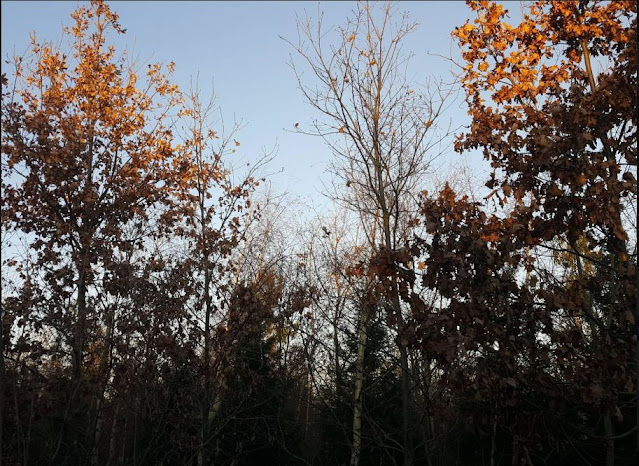
The oak on the left is the same oak as on the left in the previous photo. The photograph is from a bit further back and shows another good oak on the right hand side. These two trees are likely to be "final crop trees. The spacing being about right to give efficient crown size to both trees. The two two oaks between them would be cut down to allow that.

I had thought that this  idea was original, then I visited Norbury Park. Here Professor Jo Bradwell was doing the same, on a somewhat larger scale. He was also applying the idea to other Species. This gives me some confidence that I am not being silly. Norbury Park have a motorised telescopic pair of shears for removing the tops of the trees. (Gadget Envy). I am also doing something similar with potential timber trees at Pit Wood with cherry, Robinia and Sweet Chestnut in a less systematic way.
Professor Bradwell has referred to this as Halo Pollarding. He has used the term in print. (Norbury Park, An Estate Tackling Climate change 2022, RFS Journal July 2022 ) I have followed his lead though I think Halo Topping is a more accurate term.

A row of Birch which have been pollarded to favour the row of oaks on the right. The removal of the tops will also help the Western red cedars on the left. The cedars will be left while they do not interfere with the oaks, and will form a back up crop if there are not sufficient quality Oaks. 


This is a labour intensive way of managing. It is unlikely to be taken up commercially. The way this halo pollarding preserves standing timber promoting carbon sequestration and biodiversity means it might be an option for conservation driven woodlands to produce quality timber. Though grey squirrels and new pests and diseases make oak timber a less attractive commercial proposition, and provide wildlife woodlands with a dilemma. 


Tuesday, 6 December 2022

Drought Recovery Autumn.

 Drought Recovery Autumn.

The peak of the heat was in mid-July 2022, the drought extended until the end of August. From September there was sufficient rain to keep trees growing. October and November have seen a continuous series of weather fronts crossing the country and now November the 19th the ditch is full within a couple of inches of the top at the lowest point in the triangular field. There has had not been a ground frost in Sutton until the 22nd Nov.). By mid-November the native Oaks had started losing their leaves and most Cherry, Red Oak and Robinia had dropped. The greenest leaves are on the Sweet Chestnuts. Particularly those that were had sprouted since the drought or high temperatures, though there are not that many of them. see Drought

The same Rowan tree on the 20th July, the day after the record high temperatures, and on 19th. Nov 2022. The wilted leaves on the sweet chestnut turned brown and can be seen in the Nov. picture both trees had no green leaves at the end of July but grew new leaves once rain returned.

The image on the left shows reflushing from the trunk and probably dead branches. On the right there is similar greening from the trunk but only on the North side. The bark that was exposed to the sun on the south side looks necrotic. 


The
 browning was as much due to scorching as to drought. The worst affected trees were those on the southern edge. Most trees have subsequently produced green leaves, mainly from the trunks or close to them suggesting peripheral twig death.


Dead leaves in the crown of an E. gunnii on the left, epicormic shoots from the trunk on the right.
 

A Taiwania which appeared to die
in the drought showing epicormic
regrowth. Unusual in a conifer.

Most Eucalypts were not severely affected by the hot weather. One E. gunnii  in the area of worst affected Sweet Chestnuts had a crown of dead leaves in August. By the middle of November epicormic shoots were appearing all the way up the trunk. The tree is fuel log size and should be felled if the crown has failed, which is suggested by the amount of epicormic growth. The tree may continue growing well but growth will be into thin lateral branches. If pollarded a few verticals may dominate. The Sweet Chestnut will be reviewed after the spring flush, those without leaders will be coppiced. I may take the opportunity to coppice some of the poorly shaped Sweet Chestnuts as well. They are in amongst pole stage trees and may struggle for light. 

Saturday, 8 October 2022

Taking down the big Euc.

 Taking down the big Euc.

In the middle of the Rectangular field there is a patch of pure Eucalypts. They are of mainly 3 species  gunnii, glaucescens and dalrympeana. They were moved from the lowest part of the Triangular field after the flood of winter 2012 and planted at 1.5m spacing. The trees are of mixed diameters and mainly 40-50foot tall. The area to the East of them has been felled as part of the 2022/23 planting and they were felled before planting in this area commenced. (See Preparing for the 22/23 Planting season). The idea being to be able to fell into the cleared area without damaging any other trees large or small. They would also provide the wood fuel for 23/4 winter.

The last Euc standing.
The foreground has Alder and Poplar stumps.
The Euc stumps are further back. 
The Eucs on the South side of the block had grown best. The two largest were E. dalrympleana. The largest had been coppiced 3 years before. It's coppice regrowth is the euc to the right of the big one in the picture.
Thin etiolated stems and regrowth from previously cut stems were left to grow on. One, the other large dalrympleana remained. It could not be felled in a direction without risking other trees. I wanted to take it down as the longer it remained the bigger and more difficult it would be. It had been forked and the smaller northern limb had been removed.  

Almost no collateral damage.
Mainly Luck.
It's natural direction of fall was to the south on top of a row of not particularly fine
trees but if it fell on them it's height would demolish at least 10, a risk worth taking. I decided to fell just above the fork. The diameter was much less than lower down where my 12" chainsaw would not be able to make a simple cut. This would mean cutting from a tripod step ladder. Not a decision I made lightly. Two ratchet straps were attached above the prospective cut and tightened. They were fixed to trees in the rows either side of the row the Euc would likely fall on. On a dead still day it was cut down. When it did fall it went down between two rows of trees causing little damage to the trees. I do not claim any credit for this. The taller trees in the rows will have guided it down. I now have to cut it up and move it. With all the fuel size Eucs down I can start clearing the area building deer barriers and replacing the few gaps in the planting.

The forked area of the stump is an intrinsic weakness. (see Splitting Logs) The two limbs do not fuse and water can get between them causing rot or an instability which cases one limb to be blown down, sometimes followed by the other.  One of the main reasons for removing the fork the previous year. The cut limb had already produced coppice, strictly pollard, regrowth which I wished to preserve. Instead of cutting the raw ragged stump off cleanly I tried to cut through the main limb leaving the previous one.
The cut made the stub then had to be removed by splitting the bit before it was possible to get behind it and lever off the whole section. The cut went into the remaining limb rather further than I had hoped. Only time will tell how successful it has been. 
Removing the forked joint.


The junction between the two limbs can be seen in the third photo. The originally cut limb has been partially surrounded by the other. The live bark can be seen in the fourth photo to have been under cut and may not heal. White fungal hyphae can also be seen on the outside of the bark. How the tree responds will be interesting. My guess is that the established regrowth will make fuel logs. Hopefully the fresh cut will also regrow. 

For the record the cut length was 13.50 m to the top leaf and the height to the cut on the stump 2.09m total 15.59m or 51 ft. The girth of the stump at breast height was 1.05 m just over 13" diameter.

24/5 planting update

  24/5 Planting Update. The area next to the willow coppice. which was predominately 3/4 rows of ash and 1/2 rows of Italian Alder and Hornb...